
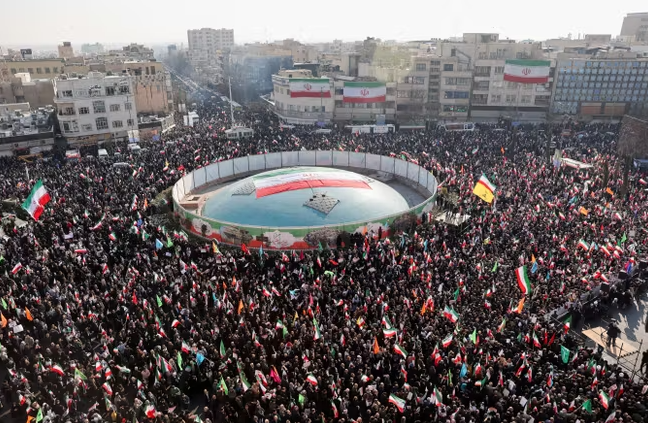
What began as an economic revolt has evolved into the most serious challenge to Iran’s ruling system since 1979.
A Crisis That Shook the Islamic Republic
The 2025–2026 Iranian protests, often described as the “Economic Uprising” or “Anti-Regime Revolution,” represent one of the most profound challenges faced by the Islamic Republic of Iran since its founding in 1979. Triggered by severe economic distress including hyperinflation, a collapsing currency, soaring food prices, and entrenched corruption, the demonstrations rapidly transformed into a nationwide movement demanding regime change, secular governance, and an end to clerical dominance.
Slogans such as “Death to the Dictator” and calls for the return of exiled Crown Prince Reza Pahlavi have echoed across major cities and rural regions alike, signaling a revolt that cuts across class, ethnicity, and geography.
“This is no longer about bread prices. It is about the legitimacy of the system itself.”
Iranian political analyst, Tehran
Economic Collapse as the Spark
Iran’s economy had been deteriorating for years, weakened by United States and Western sanctions, prolonged mismanagement, and the financial burden of regional conflicts. The June 2025 twelve-day war with Israel inflicted heavy infrastructure damage, pushing inflation to 48.6 percent by October 2025.
Power outages began disrupting daily life as early as February 2025. The national currency, the rial, fell from approximately 700,000 to 900,000 per US dollar in early 2025 to more than one million by late December. Food prices surged 72 percent year on year, placing basic necessities beyond the reach of millions.
These economic failures intersected with deeper grievances. Decades of restricted freedoms, gender inequality, and political repression had already eroded trust in the system, particularly among young Iranians. Unlike the 2022 Mahsa Amini protests, which centered on women’s rights, this uprising encompassed nearly every demographic group, including regions traditionally loyal to the state.
Timeline of Escalation
Early to Mid-2025: Pressure Builds
Sanctions, energy shortages, and war-related damage deepen economic hardship. Inflation reaches 48.6 percent by October. The rial’s decline accelerates public anger.
Late November to Mid-December 2025: Currency Freefall
The rial loses nearly half its value, crossing one million per dollar. Food inflation climbs to 72 percent. International media warns of economic implosion.
December 28, 2025: The Spark in Tehran
Protests erupt in Tehran’s Grand Bazaar after the rial plunges to 1.44 million per dollar. Shopkeepers close stores. Demonstrations spread to Hamadan.
December 29–30, 2025: Nationwide Momentum
Students join protests. Anti-regime slogans intensify. Clashes erupt as security forces deploy tear gas. The Central Bank governor resigns.
December 31, 2025 to January 1, 2026: First Bloodshed
Deaths are reported as unrest spreads to rural areas. Authorities blame foreign conspiracies. Arrests and internet restrictions begin.
January 2–7, 2026: Peak of the Uprising
Protests occur in all 31 provinces across more than 185 locations. Demonstrators chant against Supreme Leader Ali Khamenei and voice support for Reza Pahlavi. Security forces use live ammunition. Arrests exceed 18,400. Death toll estimates range from hundreds to thousands.
January 8, 2026 Onward: Blackout and Coordination
A near-total internet shutdown reduces national connectivity to about 1 percent. Coordinated nightly chants take place. From exile, Reza Pahlavi urges unity. US officials escalate warnings.
“If the killings continue, help is on the way.”
Donald Trump
January 13–14, 2026: Judicial Crackdown
Protesters are charged with moharebeh, or waging war against God, a crime punishable by death. Executions loom as protests persist in remote areas.
January 16, 2026: Hardline Defiance
Cleric Ahmad Khatami calls for executions and labels protesters “Trump’s soldiers.” Filmmaker Jafar Panahi declares the regime has collapsed “in spirit.”
Human Cost and Silence
Human rights organizations estimate that between 2,000 and 12,000 people have been killed, with more than 11,000 arrested. Many detainees face execution. The internet blackout has silenced digital media, disrupted businesses, and eliminated independent reporting.
“The blackout is not just censorship. It is economic strangulation.”
Iranian technology entrepreneur, Istanbul
Current Situation as of January 17, 2026
Protests continue at reduced levels in major cities such as Tehran, Esfahan, and Tabriz. Border regions including Sistan and Baluchistan show increasing militancy. The Revolutionary Guard remains deployed nationwide. International concern grows as diplomatic pressure mounts and threats of foreign intervention intensify.
Possible Endgames
1. Survival Through Repression
The most likely short-term outcome. The regime suppresses dissent using force while offering limited economic relief. Stability returns temporarily, but unrest simmers beneath the surface.
2. Controlled Reform
Less likely. President Pezeshkian pushes modest reforms with Supreme Leader approval. Analysts note the absence of political will for structural change.
3. Regime Collapse
A medium- to long-term possibility. Elite fractures or military defections could trigger systemic collapse. Outcomes range from democratic transition to monarchy restoration or military rule.
4. Foreign Intervention
A dangerous wildcard. US or Israeli action could destabilize the region, risking broader war and unintended consequences.
Global Reactions
European governments urge restraint. United Nations experts warn of an escalating cycle of violence. Betting markets estimate a 37 percent chance of regime collapse by the end of 2026, underscoring deep uncertainty.
Conclusion: Iran at a Crossroads
What began as an economic revolt has evolved into a defining moment for modern Iran. Whether the regime survives through repression or falls under sustained pressure remains uncertain. What is clear is that the protests have permanently altered Iran’s political landscape.
As events continue to unfold amid blackouts and violence, the world watches closely. Iran’s future, and the stability of the wider region, hang in the balance.